
HJ중공업


Climate Change and Carbon Neutrality Policy

Mid- to Long-Term Greenhouse Gas Reduction Roadmap

Category Short Term (2023–2025) Medium Term (2026–2035) Long Term (2036–2050)
Reduction Target
(Scope 1&2)
42,500 tCO2-eq 25,500 tCO2-eq NET ZERO
Action Plan Establish a carbon neutrality strategy and implementation process Develop and introduce a low-carbon workplace operating model Lead the market in eco-friendly business areas
Detailed Strategies
  • Establish a greenhouse gas reduction roadmap
  • Establish a governance system for responding to climate change
  • Identify risks and opportunities through climate scenario analysis and establish response strategies
  • Establish a response system for the GHG Target Management System and mandatory ESG disclosure requirements
  • Establish a greenhouse gas emissions management system for construction sites
  • Expand the introduction of eco-friendly vehicles across all business sites (Target: 40% / approximately 70 vehicles)
  • Expand fuel substitution for major equipment at business sites (kerosene → LNG)
  • Expand the installation of renewable energy facilities at major business sites (e.g., solar panels)
  • Secure growth drivers for the transition to an eco-friendly business portfolio (strengthen low-carbon shipbuilding capabilities through continuous R&D investment)
  • Reduce fuel oil consumption by improving operational efficiency during vessel sea trials
  • Continue expanding the introduction of eco-friendly vehicles across all business sites (Target: 80% / approximately 140 vehicles)
  • Convert existing emission-generating equipment at major business sites from fossil fuels to electricity through facility investment
  • Offset residual emissions by increasing the use of renewable energy
  • Operate and expand pilot sites powered by 100% renewable energy
  • Gain a leading position in the market for eco-friendly, low-carbon vessels & CCS-equipped vessels, and increase the share of Zero Energy Building (ZEB) projects
Short Term (2023–2025)
  • 42,500 tCO2-eq
  • Establish a carbon neutrality strategy and implementation process
  • Establish a greenhouse gas reduction roadmap
  • Establish a governance system for responding to climate change
  • Identify risks and opportunities through climate scenario analysis and establish response strategies
  • Establish a response system for the GHG Target Management System and mandatory ESG disclosure requirements
  • Establish a greenhouse gas emissions management system for construction sites
Medium Term (2026–2035)
  • 25,500 tCO2-eq
  • Develop and introduce a low-carbon workplace operating model
  • Expand the introduction of eco-friendly vehicles across all business sites (Target: 40% / approximately 70 vehicles)
  • Expand fuel substitution for major equipment at business sites (kerosene → LNG)
  • Expand the installation of renewable energy facilities at major business sites (e.g., solar panels)
  • Secure growth drivers for the transition to an eco-friendly business portfolio (strengthen low-carbon shipbuilding capabilities through continuous R&D investment)
  • Reduce fuel oil consumption by improving operational efficiency during vessel sea trials
Long Term (2036–2050)
  • NET ZERO
  • Lead the market in eco-friendly business areas
  • Continue expanding the introduction of eco-friendly vehicles across all business sites (Target: 80% / approximately 140 vehicles)
  • Convert existing emission-generating equipment at major business sites from fossil fuels to electricity through facility investment
  • Offset residual emissions by increasing the use of renewable energy
  • Operate and expand pilot sites powered by 100% renewable energy
  • Gain a leading position in the market for eco-friendly, low-carbon vessels & CCS-equipped vessels, and increase the share of Zero Energy Building (ZEB) projects

Analysis of Climate Change-Related Risks and Opportunities and Response Strategies

Physical/Transition Risks

[Unit: KRW million]

Category Type Risk Factor Risk Impact Potential Financial Impact Risk Management Cost Time Horizon Response Strategy
Physical Risk Acute Extreme weather events
(floods, heat waves, droughts, etc.)
  • Construction delays and deterioration in productivity/quality due to reduced working hours
    • Additional equipment and manpower required to make up for construction delays
  • Potential disruption of business operations or damage to shipyard facilities/equipment and vessels under construction
  • Increase in various insurance premiums
13,938 732 Short term
  • Allocate budgets for responding to climate change risks to ensure compliance with construction schedules
  • Strengthen monitoring and continuously implement advance scheduling of construction activities to prevent delays caused by extreme weather events during the summer
  • Establish and implement action guidelines and response processes for each level of extreme weather conditions, and operate rest facilities for workers
Chronic Long-term climate change
(changes in precipitation patterns, abnormally high temperatures, etc.,
resulting in increased weather uncertainty)
  • Potential damage to facilities and loss of raw and auxiliary materials due to heavy rainfall
37 16 Long term
  • Reinforce basic infrastructure and install damage-prevention facilities
  • Operate emergency response teams and establish an emergency procurement system
Transition Risk Policy Strengthening of greenhouse gas emission regulations
(GHG Target Management System and Emissions Trading Scheme)
  • Increased costs associated with greenhouse gas emission regulations and climate change policies
    • Consulting, seminars/training, recruitment of dedicated personnel, third-party verification of emissions, and purchase of emission allowances, etc.
208 147 Medium to long term
  • Assign dedicated personnel and engage external experts (consultants) to monitor climate change policies, carbon allowance prices, and related trends
  • Establish business processes for future compliance with the GHG Target Management System and Emissions Trading Scheme and continuously enhance the reliability of underlying greenhouse gas emissions data
Market Rising raw material costs
  • Increased manufacturing costs due to the transition to low-carbon alternatives and the use of eco-friendly materials
  • Continued increases in energy input costs due to strengthened carbon neutrality policies in Korea and overseas
23,846 180 Medium term
  • Monitor raw material price trends and establish annual procurement plans for major items based on procurement volume and timing, and introduce joint purchasing with industry peers and across multiple business sites
  • Gradually expand the volume and scope of eco-friendly material purchases
Reputation Growing media and stakeholder (client)
attention to
climate change issues
  • Increased costs associated with responding to media issues to improve ESG ratings, external credibility, and corporate image
68,200 1,820 Short term
  • Strengthen ESG-related corporate communications and establish company-wide media response guidelines and systems
  • Strengthen monitoring of media coverage concerning corporate environmental issues

Opportunity Issues

[Unit: KRW million]

Category Type Opportunity Expected Benefits Potential Financial Impact Opportunity Management Cost Time Horizon Response Strategy
Opportunity Products/Services Expansion of the eco-friendly construction and shipbuilding markets
  • Increase market share by diversifying the eco-friendly construction business portfolio
  • Increase revenue through growth in orders for eco-friendly vessels in response to IMO emission regulations
882,821 1,112 Medium term
  • Increase the number of green building and Zero Energy Building (ZEB) certifications
  • Strengthen capabilities in eco-friendly construction technologies, including carbon-reducing construction methods
  • Continue investing in the development of core technologies for eco-friendly, low-carbon vessels
  • Establish an ongoing monitoring system within the design organization for decarbonized vessel market trends, technologies, and policies

Major Environmental Issue Policies

Mid- to Long-Term Management Targets and Strategies for Major Environmental Factors

Category Details Unit Mid- to Long-Term Management Targets
2035 2050
Target Detailed Strategies Target Detailed Strategies
Water Consumption Water Consumption Intensity Ton/KRW 100 million 14
  • Implement performance management to achieve water consumption reduction targets
  • Establish a monitoring system for water consumption at each business site
12
  • Expand the introduction of reclaimed water utilization systems at large business sites
Waste Recycling Rate Amount recycled / Total waste generated % 90%
  • Strengthen management of waste separation and disposal performance
  • Minimize material loss rates that result in waste requiring landfill or incineration
99%
  • Continuously develop and introduce technologies for the reuse and recycling of raw and auxiliary materials
Major Violations of Environmental Laws and Regulations Environmental penalty points in PQ credibility evaluation Cases ZERO
  • Expand environmental management roles and responsibilities (R&R) at business sites
  • Continuously strengthen capabilities to respond to major violations by business division and improve relevant processes
ZERO
  • Introduce environmental performance KPIs for all employees
  • Establish company-wide environmental management roles and responsibilities (R&R)

Analysis of Risk Factors and Response Strategies for Major Environmental Issues

[Unit: KRW million]

Category Type Risk Factor Risk Impact Potential Financial Impact Risk Management Cost Time Horizon Response Strategy
Transition Risk Policy Continued strengthening of environmental policies/regulations
and legal requirements
(air, noise and vibration, waste, water pollution, etc.)
  • Increased investment and operating costs for environmental facilities and personnel by business type to comply with environmental regulations
  • Increased number of violations due to stricter regulations on environmental issues
    • Environmental penalty points in PQ credibility evaluations for public works contracts (reduced revenue due to lower competitiveness in winning contracts)
    • Increased administrative fine expenses
3,980 554 Medium term
  • Regularly conduct environmental inspections and training at business sites and continuously strengthen employees’ environmental management capabilities
  • Advance environmental management processes and management systems
  • Identify environmental regulations applicable to each business site and establish/distribute detailed response guidelines
  • Continuously expand the roles and responsibilities (R&R) and organizational capacity of the dedicated environmental department at headquarters to provide immediate operational support and ensure close coordination with business sites on environmental regulatory issues
  • Improve suppliers’ compliance with environmental laws and regulations and their environmental management capabilities
    • (strengthen environmental risk diagnosis/evaluation systems and establish support programs)
Reputation Increase in major environmental complaints
from local communities and growing media attention
  • Increased expenditures required for timely responses to simultaneous environmental complaints and media issues at individual business sites
  • Increased direct and indirect costs associated with improving ESG ratings, external credibility, and corporate image
442 130 Medium to long term
  • Strengthen ESG-related corporate communication and establish company-wide media response guidelines & a response system

Environmental Regulatory Response Strategy and Management Process

Response Strategies by Environmental Law/Regulation

Category Environmental Law/Regulation Regulatory Requirement Response Strategy
Regulations Applicable to Business Sites
(Air, Noise and Vibration,
Water Pollution, Waste, etc.)
Clean Air Conservation Act Compliance with standards for measures to control fugitive dust and other emissions
  • Conduct continuous monitoring at business sites and take immediate action in accordance with established guidelines
  • Establish, update, and distribute detailed management guidelines for each environmental law and regulation
  • Establish and operate a system to manage waste generation by type at each business site
  • Continuously expand the roles and responsibilities (R&R) and organizational capacity of the dedicated environmental department
  • Establish and implement annual environmental training and inspection plans for all business sites (employees)
  • Establish diagnostic and support programs to enhance suppliers’ compliance with environmental laws and regulations and their environmental management capabilities
Noise and Vibration Control Act Compliance with noise and vibration standards
Water Environment Conservation Act Compliance with non-point source pollution management standards
Wastes Control Act Compliance with standards for the separation, storage, and treatment of waste by type
Greenhouse Gases Framework Act on Low Carbon, Green Growth Fulfillment of tiered reduction obligations
based on greenhouse gas emission levels
  • Establish and operate a greenhouse gas emissions aggregation system (business-site-level data management)
  • Establish and implement a mid- to long-term greenhouse gas reduction roadmap (Scope 1 & 2)
  • Establish business processes for responding to climate change regulations and policies
  • Gradually expand the scope of categories included in Scope 3 emissions calculations

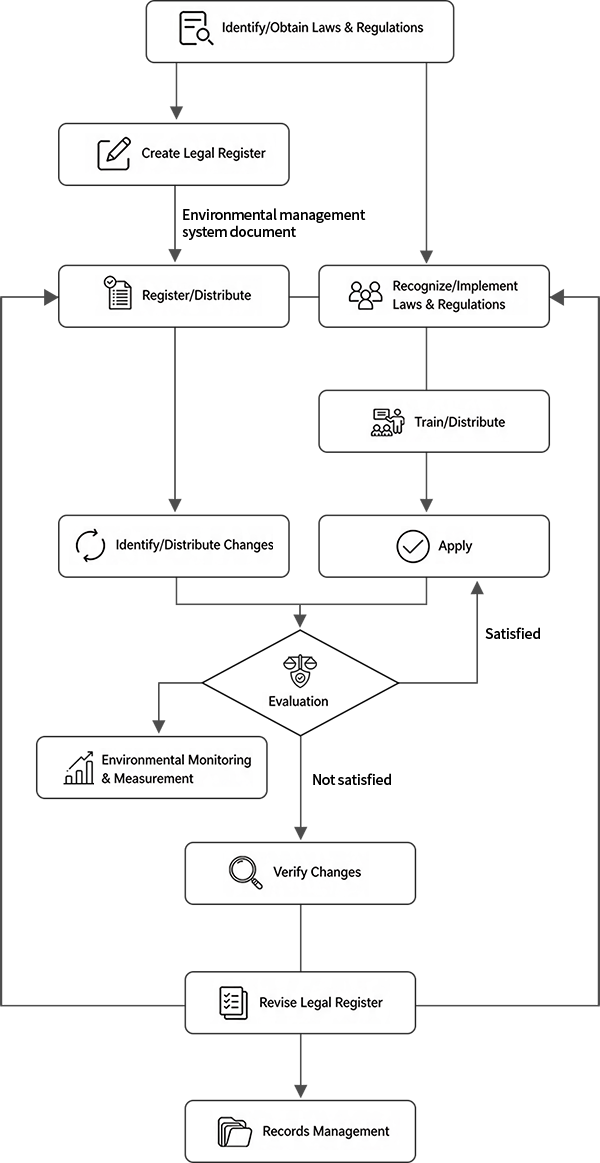
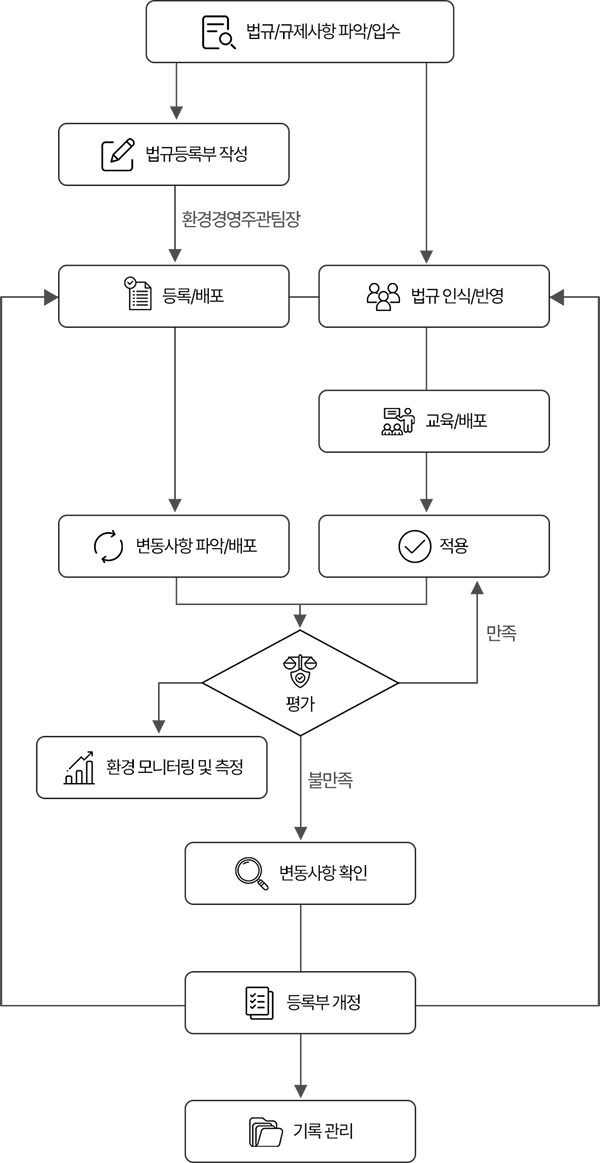
Environmental Laws and Regulations Management System

Category PROCESS Inputs Work Procedures Outputs
Environmental Management Department Team / Site
Planning Contractual requirements
Regulatory requirements
Legal requirements
Municipal ordinances
Regulations
Rules
  • The head of the responsible department and each team/site manager shall designate a person responsible for laws and regulations from among the members of the organization. The designated person shall identify and obtain applicable laws and regulations related to the relevant business, including ordinances of the competent city, county, or district.
  • The head of the responsible department shall prepare an Environmental Laws and Regulations Register for the relevant business.
  • The person responsible at each team/site shall review the company-wide register, identify additional regulatory requirements applicable to the relevant business, and prepare a team/site-specific register.
Environmental Laws and Regulations Register
Implementation Legal requirements
Contractual requirements
  • The person responsible for laws and regulations shall provide training on the prepared register to relevant organizations and distribute it where necessary.
  • The register shall be kept at the location where the relevant work is performed and used in carrying out such work.
Training Records
Inspection & Evaluation Latest laws and regulations
  • The head of the responsible department and each team/site manager shall periodically review the registers under their management and the applicable city/county/district ordinances to ensure that the latest versions are maintained.
  • If applicable laws and regulations have not been kept up to date, any changes shall be identified immediately.
    Evaluation Results
    Identified Issues
    Changes
Corrective Action & Improvement Revisions
  • The person responsible for laws and regulations shall revise the register under their management and process it in the same manner as the final registration.
  • The person responsible shall keep the register and relevant laws and regulations up to date and maintain documents generated through this process as records.
Revised Laws and Regulations Register

Environmental Laws and Regulations Management System PROCESS
Participation in Environmental Initiatives

CDP

To proactively respond to the global trend of increasingly stringent environmental regulations and demonstrate the Company’s sustainability to external stakeholders, HJ Shipbuilding & Construction joined CDP (Carbon Disclosure Project), a UK-based non-profit organization and global initiative with significant influence in the environmental sector, in 2024. The Company discloses its greenhouse gas emissions performance and environmental information annually and plans to continue its CDP-related activities to meet the climate change-related needs of its various stakeholders.

CDP Score 2024 2025
Climate Change C B
Water Security - B

BNBP

BNBP (Business for Nature N Biodiversity Platform) is an international biodiversity initiative established to support companies in actively participating in biodiversity conservation and sustainable use. HJ Shipbuilding & Construction has joined and participates in BNBP to strengthen biodiversity conservation activities related to local communities surrounding its business sites.