HJ Shipbuilding & Construction is committed to actively implementing human rights management by complying with international standards and guidelines on human rights and labor, including the Universal Declaration of Human Rights, the UN Guiding Principles on Business and Human Rights, the core conventions of the International Labour Organization (ILO), and the OECD Due Diligence Guidance. We also strive to protect the human rights of all stakeholders, including our employees, business-related parties, and customers.
HJ Shipbuilding & Construction has established and operates a systematic human rights management framework to proactively manage human rights issues across all business activities. Through a dedicated organization established based on the Human Rights Management Declaration, the Company ensures compliance with implementation guidelines, conducts human rights training and impact assessments, and effectively operates grievance mechanisms, thereby continuously fostering a culture of respect for human rights.
HJ Shipbuilding & Construction practices human rights management that values and protects human dignity and worth. This Charter declares the Company’s commitment to respecting the dignity of all stakeholders, including employees of the Company and its subsidiaries, with the aim of minimizing risks through the implementation of human rights principles, while pursuing sustainable development.
 Handling of Feedback through Human Rights Grievance Channels
| Reporting Channel | Reports Received | Cases Resolved | Resolution Rate |
|---|---|---|---|
| Online / Offline | 4 cases | 4 cases | 100% |
Human Rights Training| Category | Unit | 2023 | 2024 | 2025 |
|---|---|---|---|---|
| Total Number of Participants | Persons | 2,187 | 2,073 | 2,044 |
| Training Hours | Hours | 9,681 | 11,243 | 11,267 |
| Training Hours per Person | Hours/Person | 4.4 | 5.4 | 5.5 |
* Human rights and ethics training, sexual harassment prevention training, disability awareness training, and workplace harassment prevention training.
Mid- to Long-Term Human Rights Management Roadmap| Category | Year | Target | Detailed Action Plans |
|---|---|---|---|
| Foundation Building | 2023 | Establish the direction for human rights management |
|
| Foundation Building | 2024 | Establish a human rights management framework and assess human rights risks, focusing on the Head Office |
|
| Expanded Implementation | 2025 | Expand human rights risk management to the Company and major business partners |
|
| Short-Term Target | 2026 | Systematize human rights due diligence and human rights impact assessments for the Company and major business partners |
|
| Mid-Term Target | 2027 | Expand the scope of human rights risk management for business partners |
|
| Long-Term Target | 2028 and beyond |
Establish a human rights management system covering all business partners |
|
Key Management Indicators| Category | Short-Term Target | Mid-Term Target | Long-Term Target |
|---|---|---|---|
| Disclose the status of human rights management implementation | Once a year | Once a year | Once a year |
| Human Rights Due Diligence and Human Rights Impact Assessments for the Company | 50% conducted | 80% conducted | 100% conducted |
| Human Rights Due Diligence and Human Rights Impact Assessments for Major Business Partners Subject to Assessment | 50% conducted | 80% conducted | 100% conducted |
| Monitoring of Implementation of Corrective Actions for Human Rights Risks | - | - | At least once a year |
| Human Rights Training | At least once a year | At least once a year | At least once a year |
Human Rights Impact Assessment
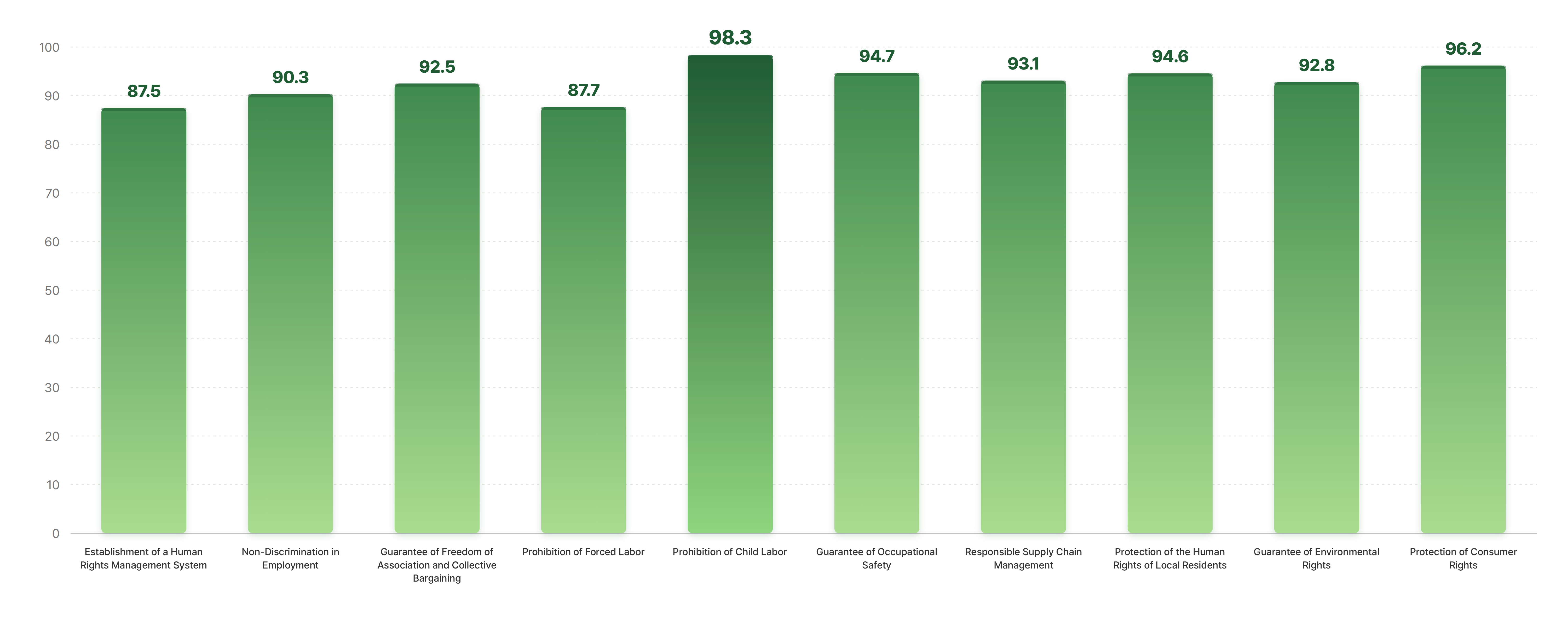
HJ Shipbuilding & Construction conducts human rights impact assessments based on the standard assessment indicators of the National Human Rights Commission of Korea to systematically review the Company’s policies, procedures, and systems related to human rights issues. In 2025, the Company conducted an assessment of its employees covering 59 items across 10 areas to evaluate their level of human rights awareness. The assessment identified certain areas requiring improvement, and the Company is implementing improvement measures accordingly.
Going forward, the Company will gradually expand the scope of its human rights impact assessments and continuously improve its assessment indicators. Through these efforts, we will identify potential human rights risks not only within the Company but also across the supply chain and local communities, incorporate improvement measures into relevant systems, and continuously enhance the Company’s human rights management practices.
Assessment Criteria| Category | Criteria | Score |
|---|---|---|
| Yes | The requirements of the indicator are considered to be fully implemented. | 1.0 point |
| Needs Improvement | The requirements of the indicator are partially implemented, but further improvement is required in terms of operation or implementation. | 0.5 points |
| No | The requirements of the indicator are currently not implemented, or relevant systems, procedures, or plans have not been established. | 0 points |
| No Information | Insufficient relevant information or supporting evidence to determine whether the requirements have been implemented. | - |
| Not Applicable | The indicator is not directly relevant to the characteristics of the department, work, or organization concerned. | - |
Human Rights Impact Assessment Results (2025)The human rights impact assessment covering 59 human rights-related items across 10 areas identified the human rights management system, non-discrimination in employment, and responsible supply chain management as areas requiring improvement. Based on the assessment results, the Company will establish and implement improvement measures for the relevant systems and procedures to further enhance its human rights management practices.